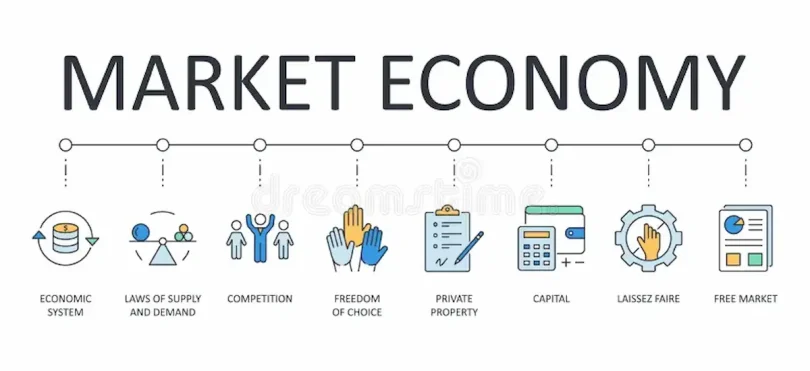

A business market economy is a type of economic system where businesses and private enterprises play a central role in driving economic activity, guided primarily by market forces such as supply, demand, and competition. In this system, the government plays a limited role, mainly ensuring legal frameworks, fair trade, and protecting property rights.
Business market economies are designed to encourage entrepreneurship, innovation, and efficiency, making them crucial for modern economic growth and global competitiveness.
What Is a Business Market Economy?

A business market economy is a system in which businesses control production, pricing, and distribution of goods and services based on market signals. Consumers influence business decisions through their purchasing choices, creating a cycle where profit motives drive productivity and innovation.
The primary objective of a business market economy is to maximize profits while meeting consumer needs, ensuring that resources are allocated efficiently and businesses remain competitive.
Key Features of a Business Market Economy
1. Private Enterprise Dominance
Businesses are primarily privately owned, and owners make independent decisions regarding investment, production, and operations.
2. Profit Motive
Businesses are motivated by profits, which incentivizes efficiency, cost reduction, and innovation.
3. Competition
Multiple businesses competing in the same market lead to better products, services, and pricing for consumers.
4. Consumer Influence
Consumer preferences directly influence business strategies, from product development to pricing.
5. Limited Government Role
The government ensures a fair business environment, prevents monopolies, and enforces contracts but does not heavily intervene in business operations.
6. Price Mechanism
Prices are determined by supply and demand. High demand encourages production, while low demand signals businesses to reduce output.
How a Business Market Economy Works
In a business market economy:
- Businesses identify market opportunities and decide what products or services to offer.
- Consumers express preferences through their purchasing decisions.
- Prices adjust naturally based on demand and supply.
- Competition drives efficiency and innovation, as businesses aim to outperform rivals and capture market share.
This cycle ensures resources are allocated efficiently, products meet consumer needs, and businesses remain profitable.
You may also like it:
Global Conflict Updates: Latest Wars, Crises & Security
World Politics Analysis: Global Power, Diplomacy & Policy
Urban Social Life: Culture, Community, and City Living
Advantages of a Business Market Economy
1. Promotes Entrepreneurship
Private ownership and profit incentives encourage individuals to start new businesses and innovate.
2. Consumer-Centric
Businesses focus on meeting consumer demands, resulting in better quality and more variety of products.
3. Efficient Resource Allocation
Resources are directed to businesses that can use them most productively, reducing waste.
4. Encourages Innovation
Competition pushes businesses to develop new technologies, processes, and products.
5. Economic Growth
Private investment, job creation, and increased production contribute to national economic development.
Disadvantages of a Business Market Economy
1. Income Inequality
Wealth and resources can become concentrated among successful business owners, creating social disparities.
2. Risk of Monopolies
Without regulation, dominant businesses may control markets, limiting competition.
3. Market Failures
Certain essential goods or services, like healthcare and education, may be underprovided.
4. Exploitation Risks
Workers or consumers may face unfair treatment if businesses prioritize profits over welfare.
5. Economic Instability
Markets can experience fluctuations, causing unemployment, inflation, or financial crises.
Examples of Business Market Economies
Countries with strong business market economies often combine free enterprise with some regulatory oversight:
- United States: A highly competitive business environment that encourages startups and innovation.
- Singapore: Known for its open market policies and pro-business regulations.
- Germany: Private enterprises drive growth, supported by legal frameworks and fair competition.
- Australia: Combines business freedom with regulatory measures to ensure economic stability.
Business Market Economy vs Free Market Economy
| Feature | Business Market Economy | Free Market Economy |
| Ownership | Primarily private businesses | Private individuals and businesses |
| Profit Motive | Central | Central |
| Consumer Influence | High | High |
| Competition | Encouraged | Encouraged |
| Government Role | Limited but regulates | Minimal intervention |
| Resource Allocation | Market-driven | Market-driven |
While both systems are market-driven, a business market economy focuses more on corporate decision-making and profitability, whereas a free market economy emphasizes overall economic freedom.
Conclusion
A business market economy emphasizes the role of businesses in shaping economic activity through profit-driven, market-oriented decision-making. By encouraging innovation, competition, and consumer choice, it contributes to efficient resource allocation and sustainable economic growth. However, limited regulation is necessary to prevent monopolies, protect consumers, and ensure fair economic opportunities.
When well-regulated, business market economies provide a dynamic environment for entrepreneurship and innovation, benefiting both businesses and society.
FAQs About Business Market Economy
1. What is a business market economy?
It’s an economic system where private businesses control production, pricing, and distribution, guided by supply and demand.
2. How does it differ from a free market economy?
A business market economy emphasizes corporate decision-making and profit, while a free market economy focuses on overall economic freedom.
3. Which countries have a business market economy?
The United States, Singapore, Germany, and Australia are examples.
4. What are the advantages of a business market economy?
Promotes entrepreneurship, innovation, consumer choice, efficient resource allocation, and economic growth.
5. What are the disadvantages?
Income inequality, monopolies, market failures, worker exploitation, and economic instability.